
Whose City? Our City!
Zohran Mamdani’s People-First Plan Challenges State Militarization and Corporate Power in New York City

When a state turns its military inwards, it raises all sorts of questions about what that state is for, and who is considered a threat. Donald Trump has been answering those questions one way. New York City Mayor-Elect Zohran Mamdani is answering differently.
The U.S. has a long history of using troops to put down the poor. It’s worth remembering that less than a decade after the American Revolutionary War, the very richest parts of Massachusetts society activated the state militia and funded their own private army to crush the poorest parts, mostly farmers and war veterans like Daniel Shays who were rebelling against foreclosures, and being heavily taxed to pay off the war debts owed to the wealthy.
Fast forward to West Virginia in the 1920s and you see miners bombed from the sky. When miners — Black, white, and immigrant — fought for their rights not to die on the job, wealthy coal companies used private militia, machine guns, and U.S. Army bombers to pound them into submission. Federal troops eventually intervened on September 2, 1921, leading to the miners’ surrender.
In the 1970s, National Guard soldiers killed students at Kent State and Jackson State for protesting a greedy war machine that was gobbling up their brothers and sisters.
What is the state for: people or property? In the last three and half decades, the richest one percent of households in the U.S. have accumulated almost 1,000 times more wealth than the poorest twenty percent of us. We’re always told the federal forces are being used to keep the public safe, but more often than not, they’re being used to dodge answering demands for change. Answering questions is not what troops are trained to do. They’re much better at suppressing dissent. But none of it is good for our democracy, and in the world’s richest and ever-more unequal nation, those questions will have to be answered some day.
Whose City Is It?
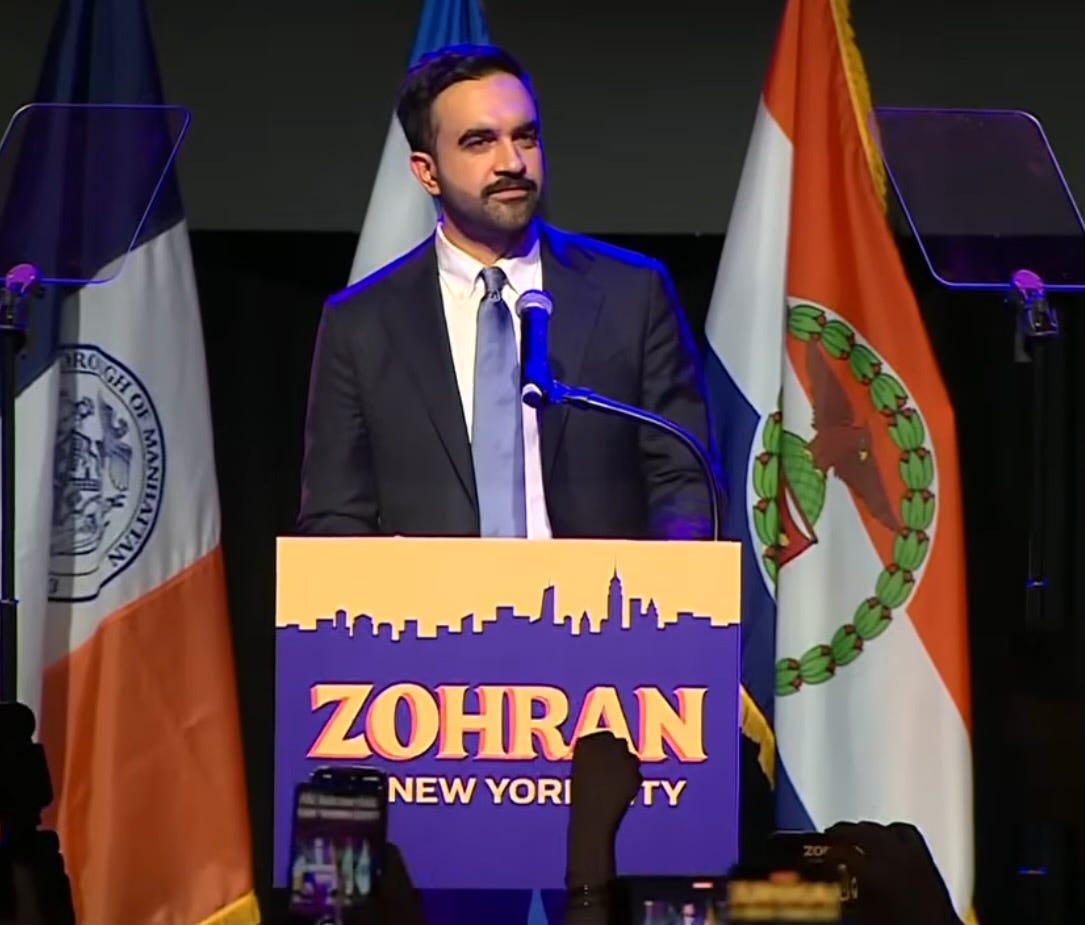
On November 4, Zohran Mamdani answered this way:
“To every New Yorker in Kensington and Midwood and Hunts Point, know this: This city is your city, and this democracy is yours too.”
Evoking a historical period in the city that was marked by ambitious and transformative public policies, Mamdani referenced Fiorello La Guardia — whose time in office (1934–1945) is remembered for major reforms and public infrastructure investment.
Pushed by the city’s massive immigrant, Left, and labor movements, La Guardia created the New York City Housing Authority (NYCHA) and built the nation’s first low-rent public housing projects. To keep costs low for New Yorkers during the Great Depression and World War II, he worked to control rents, food prices, and supported organized labor and unionization, aiming to make New York a "100 percent union city.”
Central to the media coverage of Mamdani’s victory is the mayor-elect’s charisma and his grinning defiance of the demagogue, Donald. But in his victory speech, he was very clear: it’s not just Trump the person he seeks to displace, but also the policy choices that created him. As he said:
“After all, if anyone can show a nation betrayed by Donald Trump how to defeat him, it is the city that gave rise to him. And if there is any way to terrify a despot, it is by dismantling the very conditions that allowed him to accumulate power.
This is not only how we stop Trump; it’s how we stop the next one.”
New York is well placed to be the “shining city” of Mamdani’s dreams. Public housing was born here. People’s movements fought for what was once a free, public university here — the City University of New York (CUNY).
Investing in New Yorkers — Not Corporations or Warmongers
Federal funds may be cut, but New York is a “donor state.” It sends more money to the federal government in taxes than it receives back in federal spending. Some of that flow could be redirected. And New York City is rich. If the city’s multi-billion dollar healthcare budget was spent on local service providers and vendors instead of on remote private contractors, it could revitalize entire neighborhoods. Buy local. Hire local. And how about sending more city contracts to more democratically-run businesses, like Cooperative Home Care Associates in the Bronx — the country’s largest worker-owned cooperative?
Mamdani knows how to follow the money. In 2023, he introduced the “Not On Our Dime” bill, which proposed amending the state’s nonprofit law to prohibit not-for-profit corporations from funding Israeli settlements in the West Bank, which are illegal under international law. The legislation would have stopped the flow of around $60 million annually from New York-based charities to settlements and violators could have been sued and fined by the state Attorney General. Foreign aid to far-off criminals is part of our economy too, says Mamdani, and we have a right to make new choices about it.
Now is the time to invest in publicly-owned green energy — wind and solar power, and community broadband. Alongside Mamdani’s food-for-people, not-for-profit plan, there’s no reason City Hall couldn’t put the next generation of public utilities in democratically-run public hands — and absolutely no reason to keep rate payers in hock to the price-gouging investors who own Con Edison.
To those seeking new answers to old questions about what the state is for, choosing Mamdani was easy. The work ahead will not be. Still, New York is a creative, courageous place, with a rich history and plenty of resources to conduct a grand experiment. And as Mamdani told his tired, exuberant followers on November 4:
“While we cast our ballots alone, we chose hope together. Hope over tyranny. Hope over big money and small ideas. Hope over despair. We won because New Yorkers allowed themselves to hope that the impossible could be made possible. And we won because we insisted that no longer would politics be something that is done to us.”
Now it’s not just Donald Trump who’s watching Zohran Mamdani’s New York. We all are.
"Turn the volume up.”
I talked with Zohran Mamdani about the “Not on our Dime Bill” in 2023. Readers can find that episode and years of reporting on building economic democracy in our archives at Laura Flanders & Friends. Subscribe to this newsletter here, and never miss an episode. Find out more at lauraflanders.org
No one should have to fight as hard as you have had to, to live with security in their home.
I didn't realize how much I was feeling like NYC, where I was born and raised, was no longer my city until I heard Mamdani say, "This city is your city, and this democracy is yours too.” The affordability crisis is displacing the majority. The community ties that made NY great are being replaced by folks just passing through. Remember, "the rent is too damn high?" 70% of NYers are renters. It's structural. It will take a different kind of politics to change it. Our time is now.